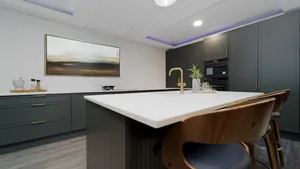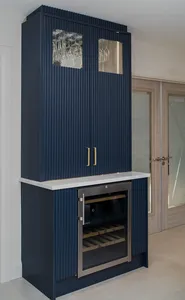
Shaker kitchen design is defined by five-piece recessed-panel doors, clean horizontal lines, and cabinetry built around function rather than decoration. Most shaker kitchens available in Ireland today, though, come flat-packed from a warehouse, sprayed in a factory abroad, and assembled by a fitter who had no involvement in the design.
That distinction matters more than the definition does. A genuine bespoke shaker kitchen is a different product entirely, and understanding that difference before you commit is what this guide is for.
What Makes a Kitchen a Shaker Kitchen
The shaker style traces back to the 18th century shaker religious communities in America, who believed good work was a form of worship. Their furniture reflected that belief: solid, honest, nothing wasted. The 18th century shaker aesthetic was not decoration for its own sake. It was function given form.
What survived into modern kitchens from that original philosophy is the five-piece door construction. A flat centre panel, held by two horizontal rails and two vertical stiles, creates the recessed profile that defines shaker cabinetry.
The construction method is not just visual. Done properly in solid wood, the frame and panel can move slightly with changes in temperature and humidity, which is why well-made shaker doors stay true for decades while cheaper alternatives warp or crack.
Classic shaker style in a kitchen means frameless fuss. No raised mouldings, no glass inserts, no ornate details competing for attention. What you see is the quality of the material and the accuracy of the join. For a homeowner, that has a practical implication: a poorly made shaker kitchen has nowhere to hide.
Why Shaker Kitchens Suit Irish Homes
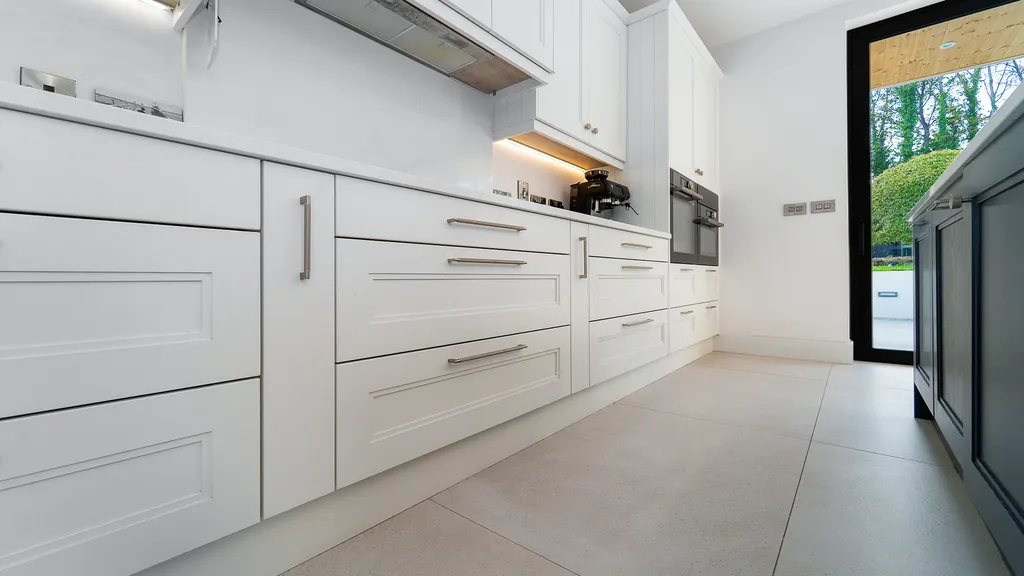
Ireland has a particular housing stock. Victorian and Edwardian red-bricks in the inner suburbs. Mid-century semis across North Dublin, South Dublin, and the commuter counties. Contemporary open-plan builds in new developments across Meath, Kildare, and beyond. Shaker kitchen design adapts across all of them in a way that very few kitchen styles manage.
In a period property, a classic shaker kitchen with hand-painted cabinetry in a heritage tone sits naturally against original cornicing and timber floors. The proportions echo the craftsmanship already in the house. A modern open-plan build asks for something different: slimmer profiles, matt finishes, a design that reads as clean and considered rather than cold. The architecture of the door does the quiet work of fitting in, in both cases.
“The shaker kitchen endures in Ireland because it suits the way Irish people actually live,” says Alan O’Connor of Aloco Kitchens. “It is not a statement kitchen. It is a kitchen that works every day for twenty years and still looks right.”
That staying power is more than sentimental. A design with no expiry date holds its value and its appeal across a full property lifecycle. For a homeowner investing in a kitchen renovation, that longevity matters in a way that kitchen trends genuinely do not.
What Makes a Bespoke Shaker Kitchen Different
A flat-pack or supply-and-fit shaker kitchen works from a fixed range of cabinet sizes, heights, and configurations. The kitchen is designed to fit what the product allows. If your kitchen is 3.4 metres wide, or has an awkward chimney breast, or a structural wall that breaks an otherwise clean run, the solution is a workaround. Filler panels, adjusted heights, compromised corners.
A bespoke shaker kitchen is designed from the room outward. Every cabinet is made to the dimensions of that specific space. Ceiling height, wall angles, window positions, the way natural light moves through the room at different times of day.
None of it is fixed until the room tells you what it needs. Cabinet heights are set to the household too. Standard flat-pack units come at fixed heights, typically 900mm to the worktop surface. A bespoke kitchen can be made taller or lower to suit the people who actually use it.
At Aloco, every kitchen is designed, manufactured in our Santry workshop, and installed by our own team. The designer who measures your kitchen is connected to the workshop that builds it. That matters.
When the person who took the measurement is accountable to the person who cuts the timber, precision does not get lost in a handover to a remote factory. Cabinet makers who see a job through from consultation to installation produce work that fits in a way a supply chain never quite replicates. For homeowners who think about environmental impact, a kitchen built locally from sustainably sourced timber and designed to last forty years produces considerably less embodied waste per year than a cheaper unit replaced twice in the same period.
If you want to work through the full cost comparison in detail, our guide to bespoke kitchen vs flat-pack covers the numbers honestly.
What Colour Works Best in an Irish Shaker Kitchen
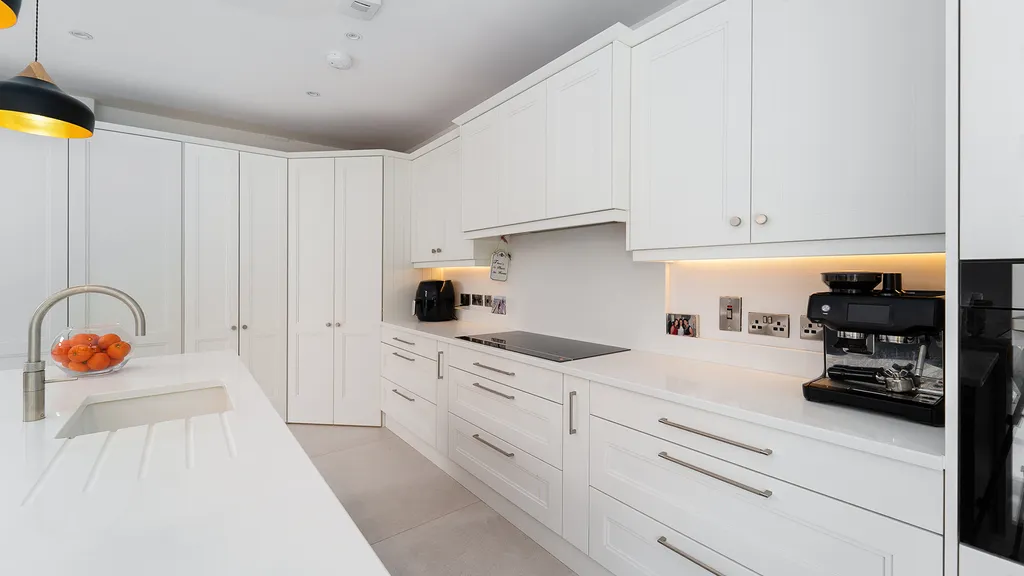
Before any colour name enters the conversation, the first question to answer is which direction your kitchen faces. In Ireland, that single variable determines whether a colour works or fails in a specific room more reliably than any trend or personal preference does.
A north-facing kitchen receives cool, indirect light for most of the day. Stark white in that context does not read as bright and clean. It reads as grey, flat, and cold. The interior magazines that make white shaker kitchens look effortless are almost always photographing south-facing rooms flooded with afternoon light. Choosing a colour from a photograph without accounting for your own room’s light is the most common mistake in kitchen planning, and the most expensive one to correct.
Warmer tones hold far better in north-facing and east-facing rooms. Off-whites with a yellow or pink undertone, muted sage greens, and soft greiges all compensate for the cool cast of indirect light. They read as neutral in the room rather than as the colour they appear on a paint chart. South-facing and west-facing kitchens can carry stronger colours without the room feeling heavy. Deep navies, forest greens, and slate blues work in spaces that receive direct sun because the light softens them through the day.
The colours that currently dominate requests at our Santry showroom, sage greens, warm greys, and two-tone combinations with a contrasting island, are not coincidental. They are what the light conditions of most Dublin homes produce when the framework is applied correctly. A green kitchen in a muted sage tone works across a wide range of orientations. A blue kitchen in navy works in rooms that can carry it.
If your read of the room turns out to be wrong, or if your taste shifts over fifteen years, a hand-painted shaker kitchen can be refreshed far more easily than a sprayed vinyl surface. That is not a marginal consideration in a kitchen that should last two decades.
Shaker Kitchen Worktops and Hardware: What to Prioritise
A shaker kitchen has visible craft in the door. The worktop and hardware either reinforce that or contradict it, and most people do not realise how much weight those two decisions carry until they see a finished kitchen where one of them is wrong.
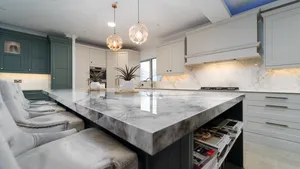
The governing principle for worktops is substance. Shaker cabinetry has depth and texture. A thin laminate surface or a busy patterned finish draws attention away from the door and makes the whole kitchen read as cheaper than it is. Natural stone and quartz work well because they have their own quiet presence without competing with the cabinetry.
Engineered stone is the most practical choice for a family kitchen: consistent in colour, hard-wearing, and easy to maintain over the kind of daily use a busy kitchen actually sees. Timber worktops suit a farmhouse kitchen or a country kitchen where the natural material connects to the warmth of the painted doors. On an island specifically, a timber surface alongside stone perimeter worktops is a combination that photographs well and holds up to daily use.
Hardware follows a different principle. The original shaker tradition used cup pulls and small knobs that served the door without decorating it. Hardware that draws the eye is hardware working against the design.
The finish should connect to the colour of the cabinetry rather than contrasting with it for its own sake. Brushed brass suits warmer painted tones. Matt black works with cooler greys and deep blues. Satin nickel sits cleanly against softer neutrals. Placement matters as much as finish. Cup pulls on lower drawers and knobs on upper doors follow the proportions the original shaker door and drawer was designed around.
Ignoring those proportions, by using the same hardware format throughout regardless of the cabinet type, is a small decision that quietly flattens a kitchen the door was designed to carry.
What a Kitchen Island Adds to a Shaker Design
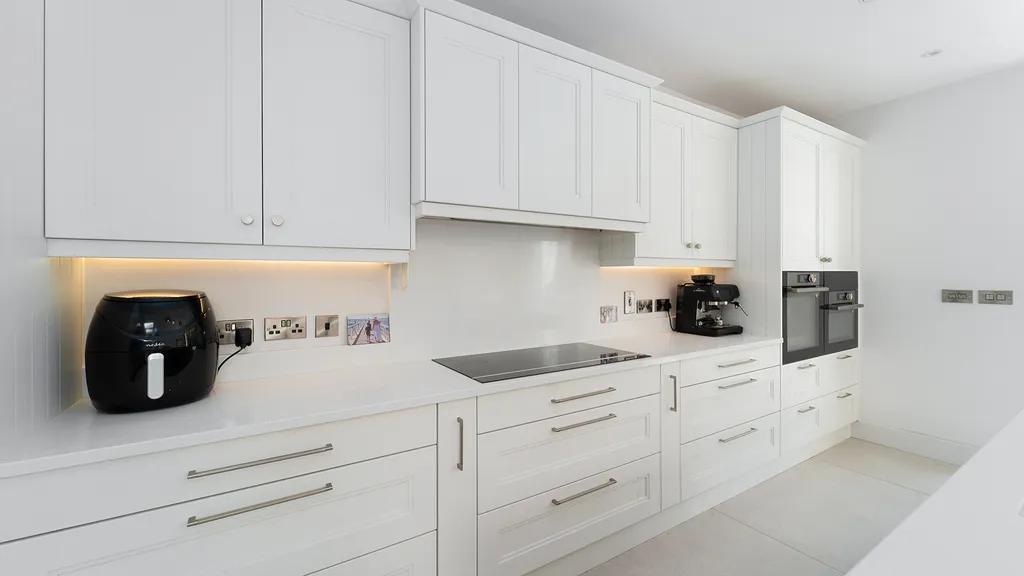
Not every kitchen needs an island. But in an open-plan space with enough room to move freely on all sides, a kitchen island with shaker doors that match the perimeter cabinetry pulls the whole design together in a way that nothing else does.
An island adds a second working surface, additional storage, and a social pivot point in the kitchen. In a shaker kitchen, the island gives the design an anchor. Done well, it looks as though it has always been there.
The practical questions matter here as much as the visual ones. An island needs a minimum of 90cm of clearance on each working side. In smaller kitchens, a peninsula attaches to one wall rather than standing free, and it delivers the same working surface and storage without claiming floor space the room cannot spare.
What Are the Disadvantages of Shaker Cabinets?
Any honest guide should answer this question directly.
The recessed panel of a shaker door creates a groove that collects dust and grease over time. In a busy kitchen, particularly around the hob, this requires regular cleaning. It is not a major maintenance burden, but it is a real one. A slab door with no profile is easier to wipe down in under a minute. A shaker kitchen door takes slightly longer.
In a kitchen with very low ceilings, or in a very small kitchen, the frame-and-panel door can make the space feel busier than a minimal flat-front design would. A slim shaker profile, with a narrower frame than the classic proportions, is a practical middle ground. It retains the character of the shaker style without the visual weight of the full-frame door.
The third consideration is quality variation. More than almost any other kitchen style, a shaker kitchen reveals the quality of its construction. A cheap shaker kitchen looks cheap in a way that a cheap contemporary kitchen does not.
The recessed panel has nowhere to hide poor joinery, uneven paint, or doors that are not quite true. If you are investing in a shaker kitchen, invest properly.
How Long Does a Shaker Kitchen Last?
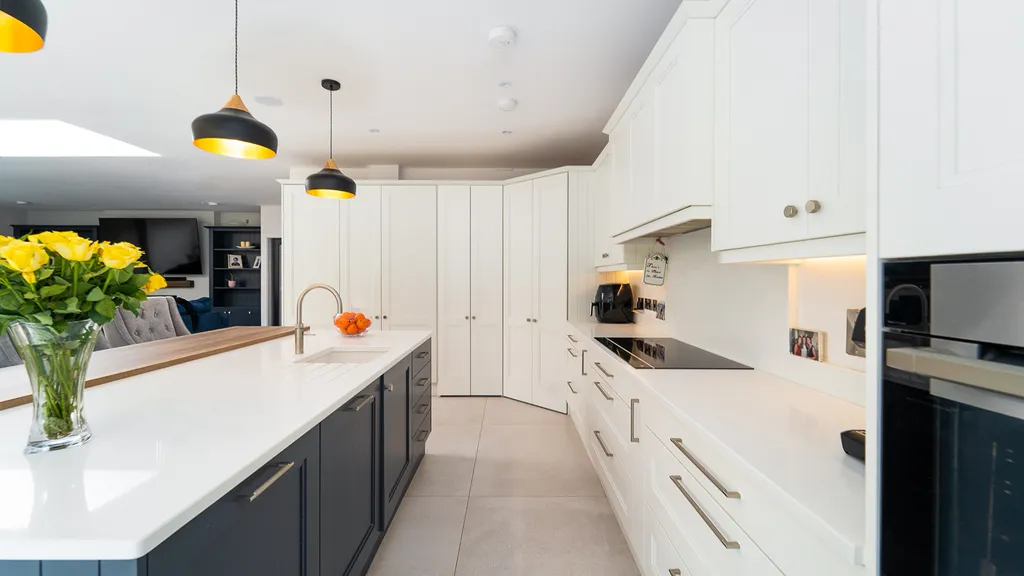
A well-made solid wood shaker kitchen, built with proper mortise and tenon joinery and finished in quality paint, should last forty years or more with normal maintenance. Some of the kitchens Aloco installed in Dublin homes in the 1980s and early 1990s are still standing. The design does not date. The materials do not fail if the construction is sound.
A flat-pack shaker kitchen built from MDF or particleboard with a vinyl wrap has a more typical lifespan of 8 to 15 years in a busy family kitchen. The failure mode is predictable: edge delamination and swelling appear first around the sink, the hob, and door edges that take daily contact. That is not a critique of every budget kitchen. It is an honest answer to the question of longevity.
A flat-pack kitchen replaced twice in forty years costs more than one well-made kitchen that does not need replacing. That is the arithmetic. The upfront saving on the cheaper version is real. Whether it is still a saving at year sixteen is the question worth answering before you decide.
If you are starting to think about budget, our guide to what a new kitchen costs in Ireland gives current 2026 price ranges across all specification levels.
How to Choose Between Modern and Classic Shaker
The distinction between a modern shaker kitchen and a classic shaker kitchen comes down to proportions and finish rather than any fundamental design change.
A classic shaker style uses wider stiles and rails, traditional cup-pull hardware, and finishes that lean toward heritage tones and natural materials. It suits period properties and country style homes. It pairs naturally with a farmhouse kitchen aesthetic and timber or stone worktops.
The contemporary version keeps the same five-piece door construction but reduces the weight of the frame. Slimmer profiles, cleaner hardware lines, and a more restrained colour palette. In a new-build open-plan home, where the kitchen sits within a larger living space, that reduced visual weight lets the design sit within the room rather than commanding it.
If you are drawn toward that direction, our contemporary kitchen collection shows how it looks in practice.
Neither direction is more correct. The right one is the one that responds to the house and the way the household actually uses the kitchen. A 1930s semi in Clontarf calls for something different to a new-build open plan in Ashbourne, even if both homeowners want a shaker kitchen.
Bespoke Shaker Kitchen Ideas for Dublin Homes
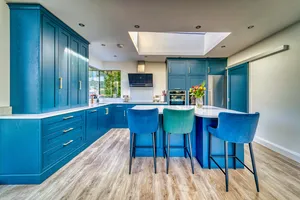
One of the most requested shaker kitchen ideas in our showroom at the moment is the two-tone painted kitchen: perimeter cabinetry in a lighter shade and a contrasting island in a darker or bolder colour. A classic shaker style base with a bold design island works particularly well in south-facing rooms where the stronger colour does not close the space down.
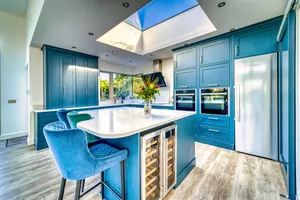
A contemporary shaker kitchen in a deep navy with brass hardware and white quartz worktops is a combination we have returned to more than once in recent years. It photographs well but, more importantly, the matt painted finish and quartz surface hold up to daily family use without showing wear the way gloss lacquer or laminate does.
For period properties in North Dublin, a country kitchen approach with a painted kitchen in warm off-white or stone, traditional hardware, and a timber worktop on the island remains a consistent choice. It looks like it belongs to the house because, designed well, it does.
If you are in the early stages of planning a kitchen renovation, the most useful thing you can do is see real examples made by real craftspeople. Not a showroom of static displays. Visit us in Santry and bring your measurements, your photographs, and your questions.
Most homeowners find the process far less disruptive than they expected once it is properly planned and sequenced. The conversation is free and there is no obligation to go further until you are ready.
Book a free design consultation with the Aloco team
Your kitchen is a forty-year decision. It is worth getting right.