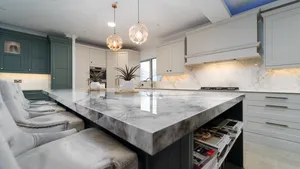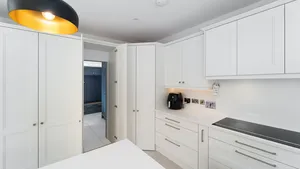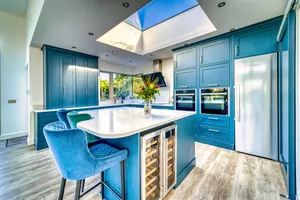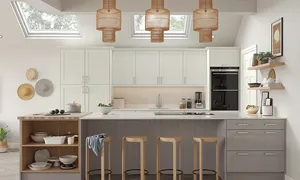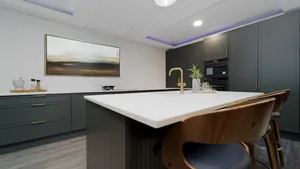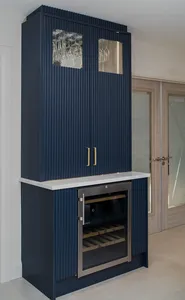
Shaker kitchen cabinets are the most popular kitchen style in Ireland because they work in almost every home, regardless of age, size, or layout.
Simple construction that does not compete with anything around it, sitting as comfortably in a Victorian terrace as in a modern extension or a new build without looking like it is trying too hard. Most homeowners who choose the wrong style figure it out too late, once everything is fitted and the kitchen feels slightly off against the rest of the house.
If you’re deciding whether shaker is right for your home, the short answer is that it probably is. The longer answer is what helps you choose the right version of it.
What Defines a Shaker Kitchen Cabinet
A shaker kitchen cabinet is defined by a recessed centre panel set within a four-rail flat frame, with no applied decoration or ornate moulding. The design is rooted in a tradition of making objects that are built to last and free of anything unnecessary. It remains the most requested kitchen door profile in Ireland because it adapts to almost any home without competing with the space around it.
Most kitchen styles are defined by what they add. Ornate mouldings, carved details, elaborate door profiles. The shaker kitchen is defined by what it leaves out.
The defining feature of a shaker door is a recessed centre panel framed by four flat rails. No applied decoration. No unnecessary detail. Just clean lines, precise joinery, and a construction method that has not changed because it does not need to.
That simplicity is not a compromise. It is the whole point.
The original shaker design came from a community that believed objects should be made with care, built to last, and constructed without embellishment. That community built furniture that outlasted everything made around it. That same philosophy translates directly into the kitchen. A shaker door does not distract. It lets the colour, the countertops, the hardware, and the space itself do the talking.
The result is a kitchen that feels considered rather than crowded.
Why Shaker Kitchens Suit Irish Homes
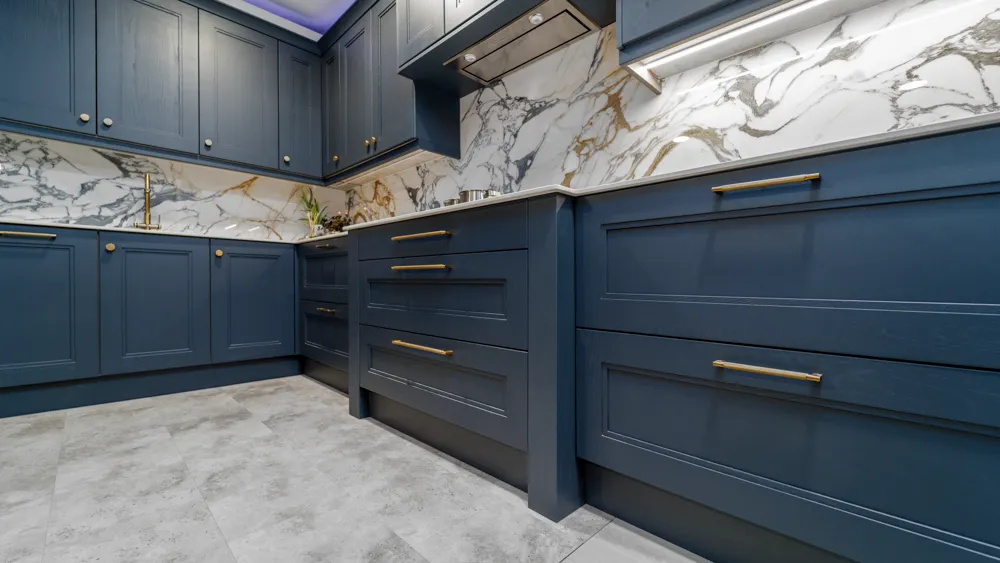
Walk through enough Irish homes and a pattern becomes clear. Period terraces in Drumcondra. Extended semis in Swords. New builds in Maynooth. Georgian townhouses off the South Circular Road. The proportions vary enormously, but the kitchens that sit comfortably in all of them tend to share one thing: restraint.
Irish homes are not usually designed around the kitchen as a showpiece room. The kitchen is a room that has to earn its place. It has to accommodate a family, handle everyday use, connect to dining and living spaces that each have their own character. A kitchen that is too visually dominant fights against everything around it.
Shaker cabinetry does not fight. It settles in.
The clean frame of a shaker door works in a low-ceilinged Victorian terrace where heavy ornamentation would feel oppressive. It works in a contemporary extension where a more traditional kitchen door style would look out of place. It works beside exposed brick and beside smooth plaster. The style is genuinely versatile in a way that most kitchen styles are not.
That adaptability is not a recent trend. It is why shaker kitchens in Dublin have been specified across every type of property for forty years, from red-brick period terraces to contemporary rear extensions.
According to Census 2022 housing tenure data, 66% of Irish households are owner-occupied. That matters here. When you own the home you live in, a kitchen is not a short-term cosmetic decision. It is a long-term investment in a room you will use every day, and the style you choose needs to still feel right in fifteen years. Shaker has been making that case for a long time.
The Cabinet Construction Is Where the Difference Really Starts
Not all shaker cabinets are made the same way, and this is where it pays to ask the right questions.
The cabinet carcase, the box structure behind every door and drawer, determines how a kitchen holds up over twenty to thirty years. That is the minimum you should expect from properly made cabinetry. Solid ash or solid oak carcases outlast MDF alternatives. The quality of the hinge, the drawer runner, and the internal hardware determines whether the kitchen still feels tight and precise a decade after installation.
A shaker door built from solid wood with properly painted or hand-painted finish behaves differently from a foil-wrapped version at a lower price point. The paint finish on a quality shaker door can be touched up if it needs to be. A foil-wrapped door, once damaged, cannot. Choosing solid timber and a repairable painted finish is what makes long-term performance possible in practice, not just in theory.
Every kitchen produced in our Santry workshop is made to a specific brief for a specific home. The cabinet makers working there have been building this type of cabinetry for decades. Each door, each panel, each drawer front is cut to your exact measurements and your layout. Nothing is pulled from a warehouse. Nothing is a standard size squeezed to fit. You can see the full range of our shaker kitchen design options, finishes, and styles on our dedicated page.
Colour Options That Irish Homeowners Actually Choose
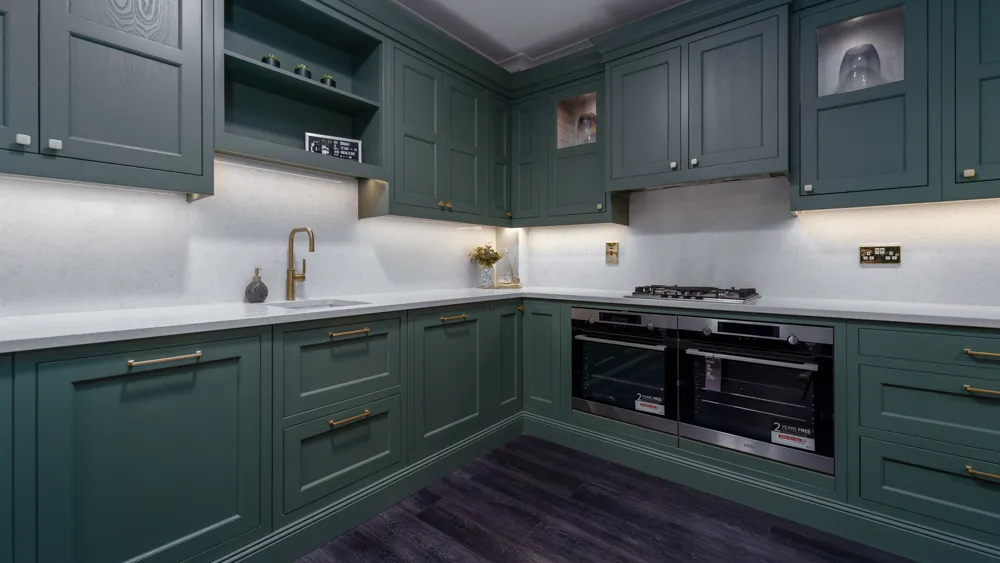
One of the most useful things about the shaker kitchen is how it holds colour. Because the door profile is simple, the colour reads clearly. There is no shadow or carved detail competing with the paint finish. What you choose is what you see.
For Irish kitchens, the most popular colours tend to fall into a few clear groups.
Off-whites and warm creams remain the most requested finish, particularly in older properties where the kitchen needs to feel light without feeling clinical. A matt or eggshell finish in a warm white gives a shaker kitchen a softness that gloss white never quite achieves.
Painted greens, from sage through to deeper forest tones, have moved from fashionable to established. They sit naturally in Irish homes because they connect visually to the landscape outside, and they pair well with both natural timber worktops and with quartz.
Two-tone schemes are increasingly common across Dublin kitchens. A mid-toned slate on lower cabinets paired with a lighter upper finish, or painted lowers combined with natural oak uppers, gives a kitchen layered depth that photographs well and lives even better. Grey, slate, and blue-grey palettes suit this approach particularly well.
Deeper navy, charcoal, and black finishes are increasingly popular for kitchen islands or accent pieces where a homeowner wants contrast without committing the whole kitchen to a darker palette.
The range of colours available in a truly bespoke shaker kitchen is not limited to a manufacturer’s catalogue. It is as wide as the paint reference you bring to the consultation.
Choosing Hardware for a Shaker Kitchen
A shaker kitchen door is a blank canvas for hardware. The profile stays the same. The handle or knob changes the entire character of the room.
Simple cup handles in brushed brass read as warm, period-influenced, slightly country in feel. Paired with off-white cabinetry and a marble-effect quartz worktop, they create a kitchen that feels genuinely timeless without trying to replicate a particular era.
Slim bar handles in brushed steel or matte black push the same shaker door towards a more contemporary finish. Clean, precise, unfussy.
Want something more tactile? Knobs in ceramic, black iron, or aged brass shift the whole feeling towards something handcrafted and grounded.
The shaker door works with all of them. That is the point. The door is not making a strong statement of its own, so the hardware, the worktops, and the accessories you choose can make it instead.
Shaker vs. Micro Shaker: Which Is Right for Your Kitchen?
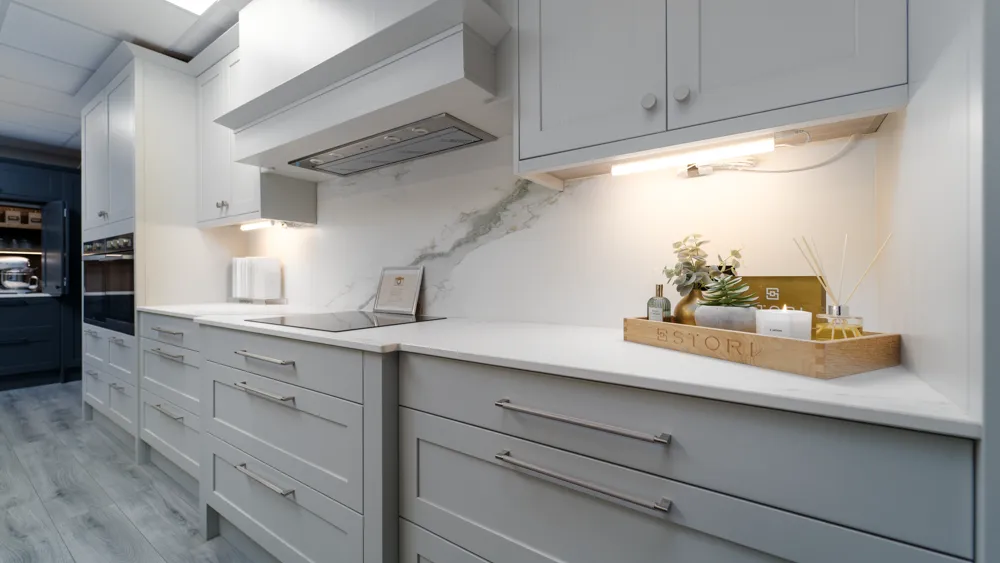
The micro shaker door follows the same principle as the classic shaker but with a narrower frame around the recessed centre panel. It is a subtler version of the same design.
A classic shaker door has a frame typically 60 to 70mm wide. A micro shaker reduces that to around 30mm. The result is a door that reads as lighter and more linear, making it a natural fit for contemporary kitchens where the priority is clean geometry over traditional warmth.
Both work well in Irish homes. The choice usually comes down to the character of the property and what the rest of the kitchen design is doing. In a period home or a traditional kitchen, the wider frame of the classic shaker reinforces the craftsmanship and weight of the design. In a contemporary extension or a new build, the micro shaker tends to sit more naturally.
If you are unsure which is right for your space, our complete kitchen planning guide covers how to match your kitchen style to your home before you ever book a consultation.
What Separates a Good Shaker Kitchen From a Great One
The shaker kitchen is one of those designs that’s easy to do adequately and genuinely difficult to do brilliantly. The simplicity of the door profile means that the quality of everything else is completely exposed.
A shaker kitchen fitted with low-quality carcases, imprecise installation, or hardware that doesn’t suit the finish will look correct but feel cheap. The lines that should be satisfying will be slightly off. The drawers that should close with soft precision will not.
A great shaker kitchen built with the right materials, properly designed storage solutions, and installed by a team that understands what precision looks like in practice is a completely different experience. You feel it before you can explain it. In our experience, most people who walk into a well-made shaker kitchen comment on how it feels before they comment on how it looks. That is not a coincidence. It is the result of getting the construction right.
Forty-four years of kitchen projects have taught the team at Aloco Kitchens exactly what that difference looks like at every stage, from the initial design through to the final day of installation. Our installation team works to a standard where the detail at the end of a run of cabinets, the way a corner is handled, the way an appliance is integrated, receives the same attention as the centrepiece of the kitchen. A family building kitchens in Dublin since 1980 simply knows where things go wrong, and makes sure they don’t.
Why Shaker Kitchens Age Better Than Other Styles
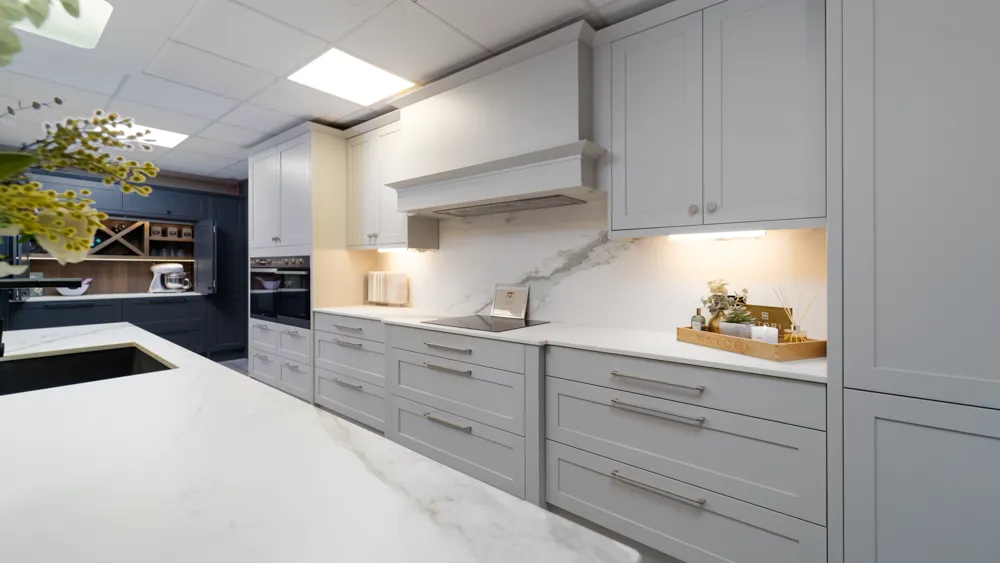
Trend-driven kitchen styles date. A kitchen that was designed to look current in 2015 often looks obviously dated now. The materials, the profiles, the colour choices that were everywhere at a particular moment in the design cycle become a timestamp.
The shaker kitchen does not date in the same way. The style is old enough that it sits outside trend cycles entirely. A shaker kitchen built with the right materials and the right colours in 2025 will look right in 2040. No defending it. No explaining it. Just a kitchen that was well made and well chosen.
For Irish homeowners investing in a kitchen that is expected to last, that longevity has real value. A kitchen that looks good for thirty years is worth more than one that looks fashionable for five. For most homeowners, that means making this choice once, properly, and never having to think about it again.
A family in a 1920s Drumcondra terrace replaced an awkward, boxed-in kitchen with a bespoke shaker design: off-white uppers, sage lowers, and a timber worktop. Five years on, minor scratches on the door fronts were retouched with the original paint. No replacement. No disruption. The kitchen looked, and functioned, exactly as it did on the day it was installed. That is what the right materials and the right construction method actually deliver.
Frequently Asked Questions
What is a shaker kitchen cabinet? A shaker kitchen cabinet has a flat recessed panel set within a four-rail frame. No carved detail, no applied moulding. The construction is straightforward, which is exactly why it works so well alongside other materials, colours, and hardware choices. The simplicity is the feature, not a limitation.
How much does a shaker kitchen cost in Ireland? The range is wide. A flat-pack shaker-style kitchen from a retailer can start from a few thousand euros. A bespoke shaker kitchen, designed, manufactured, and fitted to your exact space and specification, is a different category of product with a different price point. The more relevant question is what you want the kitchen to do over the next twenty to thirty years. Most homeowners who invest in a properly built bespoke shaker kitchen do not replace it. Those who buy on price often do.
Are shaker kitchens still popular in Ireland? Yes, and consistently so. Shaker remains the most requested door profile across bespoke kitchen workshops in Ireland and the UK. It has not peaked because it was never purely a trend. The design sits outside fashion cycles, which is why it has been the dominant choice for decades and shows no sign of changing.
What is the difference between a shaker and a micro shaker kitchen? The frame width. A standard shaker door has a frame of around 60 to 70mm. A micro shaker reduces that to approximately 30mm, giving the door a lighter, more linear appearance. Classic shaker suits period homes and traditional kitchens. Micro shaker tends to work better in contemporary extensions and new builds where the priority is clean geometry. Both are made using the same principles. The choice comes down to the character of your home and what you want the kitchen to feel like.
Book a Free Shaker Kitchen Consultation in Dublin
If you’re at the stage of researching shaker kitchens in Dublin or the wider Leinster area, the next useful step is a conversation with someone who has designed and built enough of them to help you understand what is actually possible in your space.
At our Santry showroom, you can see exactly how different shaker door styles, finishes, and hardware combinations look alongside real worktop samples, cabinetry details, and completed kitchen projects. That combination of seeing, touching, and asking questions cannot be replicated online.
Bespoke shaker kitchens from Aloco are designed, manufactured, and installed entirely in-house. From the first consultation through to the day our installation team leaves your home, every decision is made by people who have seen enough kitchen projects to know exactly where the details that matter most are usually missed. The fitting process is managed entirely by our own team, so you are not coordinating between suppliers or chasing tradespeople.
Book a free consultation and see exactly what a bespoke shaker kitchen could look like in your home. You’ll leave with a clear picture of what’s possible, what it involves, and what it would cost.
The kitchen is the room you will use every day for the next thirty years. It deserves more than a catalogue.